Lidodao voting: LDO votes compared with Easy Track
Lido DAO governs Lido's liquid staking protocol through LDO-weighted decisions. Easy Track handles routine, uncontentious DAO motions through an on-chain veto model, reducing the need for repeated full votes on operational matters.
LDO voting power
LDO is Lido DAO's ERC-20 governance token on Ethereum. Voting weight is proportional to the LDO balance counted under the applicable voting mechanism.
The token supports historical balance and total-supply snapshots. These let voting systems reference recorded balances, helping prevent token movements during an ongoing vote from manipulating voting power. The balance reference used for a particular vote matters when interpreting a holder's weight.
LDO and the staking tokens have separate roles: stETH and wstETH represent staking exposure and can be used to signal opposition to covered protocol actions through Dual Governance, while LDO supplies voting power for LDO-weighted governance.
Decision routes and timing
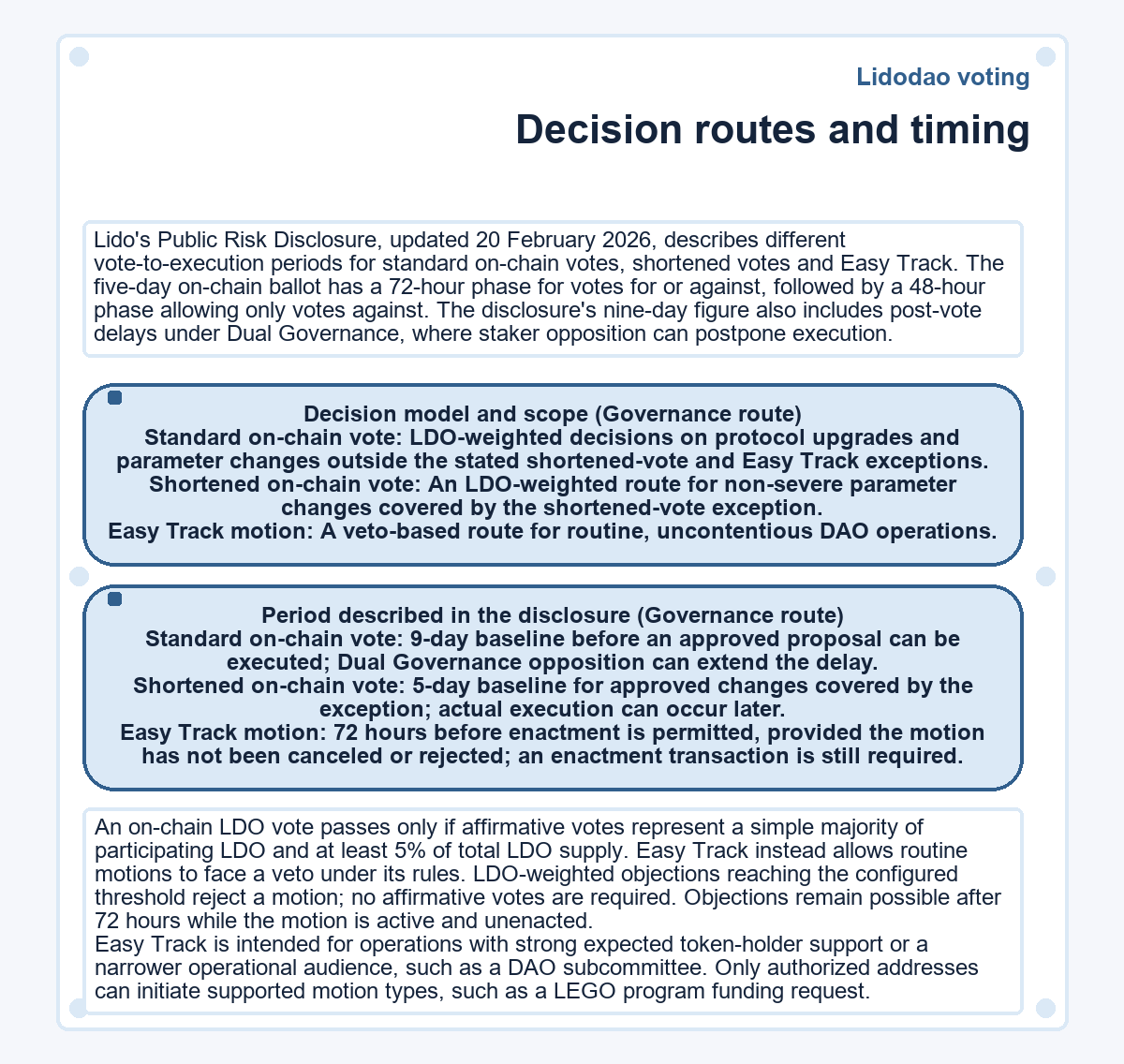
Lido's Public Risk Disclosure, updated 20 February 2026, describes different vote-to-execution periods for standard on-chain votes, shortened votes and Easy Track. The five-day on-chain ballot has a 72-hour phase for votes for or against, followed by a 48-hour phase allowing only votes against. The disclosure's nine-day figure also includes post-vote delays under Dual Governance, where staker opposition can postpone execution.
| Governance route | Decision model and scope | Period described in the disclosure |
|---|---|---|
| Standard on-chain vote | LDO-weighted decisions on protocol upgrades and parameter changes outside the stated shortened-vote and Easy Track exceptions. | 9-day baseline before an approved proposal can be executed; Dual Governance opposition can extend the delay. |
| Shortened on-chain vote | An LDO-weighted route for non-severe parameter changes covered by the shortened-vote exception. | 5-day baseline for approved changes covered by the exception; actual execution can occur later. |
| Easy Track motion | A veto-based route for routine, uncontentious DAO operations. | 72 hours before enactment is permitted, provided the motion has not been canceled or rejected; an enactment transaction is still required. |
An on-chain LDO vote passes only if affirmative votes represent a simple majority of participating LDO and at least 5% of total LDO supply. Easy Track instead allows routine motions to face a veto under its rules. LDO-weighted objections reaching the configured threshold reject a motion; no affirmative votes are required. Objections remain possible after 72 hours while the motion is active and unenacted.
Easy Track is intended for operations with strong expected token-holder support or a narrower operational audience, such as a DAO subcommittee. Only authorized addresses can initiate supported motion types, such as a LEGO program funding request.
What governance can change
DAO decisions cover protocol fees, upgrades and operator or oracle arrangements. Treasury responsibilities include funding research, development, LEGO grants and contributor payments. Changes approved through governance can affect protocol behavior, reward mechanics or token functionality.
Independent node operators perform validator duties, while oracle systems provide data the protocol contracts use for accounting. Governance determines parameters and arrangements around those functions; validator operations and oracle reporting remain distinct technical responsibilities.
Discussion and execution
Lido's governance stack includes forum discussion, off-chain votes and on-chain votes. Discussion provides a place to develop initiatives, and off-chain voting records preferences. On-chain DAO governance operates on Ethereum, where execution applies an authorized change through the relevant contracts.
A favorable off-chain result alone does not establish an executed protocol change. For decisions requiring no on-chain action, a successful off-chain vote can be the final step.
The LDO voting mechanism can itself be upgraded through governance. Historical votes therefore need to be interpreted under the rules applicable to those votes.